
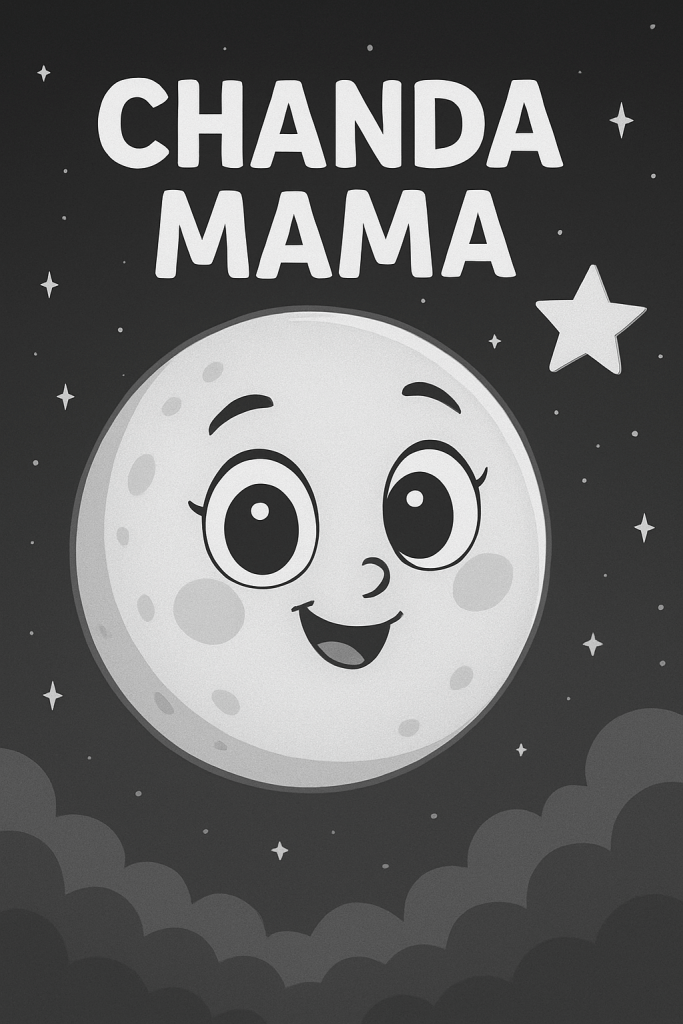
“Chanda Mama Door Ke, Pue Pakaye Gud Ke…”
Few lines in Indian childhood evoke as much warmth, nostalgia, and emotion as these.
For decades, “Chanda Mama” has been more than just a rhyme — it has been a bridge connecting generations, carrying with it stories of innocence, comfort, and unconditional love.
When we look back on our earliest memories, many of us recall sitting under the open sky, watching the bright full moon as someone — a mother, grandmother, or elder — softly sang this song. It was a lullaby, a poem, and a promise that the night was kind and the world was safe.
The Origin and Meaning of “Chanda Mama”
“Chanda Mama” is an affectionate term in Hindi that translates to “Uncle Moon.” In Indian culture, the moon is personified as a friendly guardian — someone far away yet deeply familiar.
For generations, the moon has been part of Indian storytelling, symbolizing purity, protection, and dreams.
This rhyme paints a simple picture — the moon as a loving figure who travels from afar, cooking sweets for children, watching over them from the sky.
It’s an image that reflects the innocence of childhood imagination, where even the moon becomes a friend.
The Cultural Legacy
Across India, “Chanda Mama” is not limited to one language.
There are versions in Hindi, Bengali, Tamil, Telugu, Marathi, and even regional folk variations — each carrying the same warmth but different regional flavors.
The rhyme often forms part of a child’s earliest learning experience — introducing rhythm, repetition, and comfort.
Parents and teachers have used it for decades to help children develop language skills, focus, and musical rhythm.
But more than that, “Chanda Mama” represents a time when learning was simple, songs were soulful, and nights were filled with stories instead of screens.
Why “Chanda Mama” Still Feels Fresh
Even today, when we hear those words, something stirs within us. The rhyme feels timeless.
Perhaps it’s because it connects us to a simpler version of ourselves — one unburdened by deadlines and distractions.
In an age where everything moves fast, “Chanda Mama” reminds us to slow down. It takes us back to nights when all we needed was a song, a smile, and the soft light of the moon.
This rhyme also continues to find new life in modern forms — animated videos, children’s books, and educational music for toddlers. Yet, no matter how it’s presented, the soul of the rhyme remains unchanged: gentle, loving, and deeply familiar.
The Emotional Power of Nostalgia
Nostalgia is a strong human emotion.
When adults hear “Chanda Mama,” they don’t just remember the lyrics — they remember how it felt to be held, to be safe, to be loved.
That’s what makes this rhyme so powerful.
It reminds us of:
- The security of family bonds
- The beauty of simple storytelling
- The connection between generations
- The shared rhythm of love through music
The moon, through this rhyme, becomes more than a celestial object. It becomes a symbol of continuity — the same moon our ancestors watched, the same moon that watches over our children today.
The Educational Value Behind the Rhyme
“Chanda Mama” is not just poetic nostalgia; it’s also educational.
For young children, rhymes like this play a vital role in early development.
Here’s how:
- Language Building: The repetition of sounds and words strengthens speech and vocabulary.
- Memory Development: Simple verses help children remember patterns and recall sequences.
- Emotional Comfort: The calming rhythm makes children feel secure, reducing anxiety and helping with sleep.
- Cultural Connection: It introduces values of affection, curiosity, and imagination — deeply rooted in Indian tradition.
When parents sing “Chanda Mama” today, they’re not just continuing a song — they’re continuing a legacy of learning through love.
Why “Chanda Mama” Deserves to Be Shared Again
If there’s one thing worth passing on to the next generation, it’s the spirit of simplicity and imagination.
Rhymes like “Chanda Mama” are not just entertainment; they are gentle tools of bonding and emotional growth.
Singing it to your children or students is more than nostalgia — it’s a way of giving them a small piece of your own childhood.
It’s a chance to say, “This is what made me smile. This is what made me dream.”
And perhaps years from now, they will do the same — sing “Chanda Mama” to their own children, under the same moon that watched over us all.
Final Thoughts: The Glow That Never Fades
“Chanda Mama” is more than a nursery rhyme — it’s a piece of our collective soul.
It’s a lullaby that has outlived time, language, and distance.
Even today, when we look up at the moon, it’s comforting to know that somewhere, a parent is still singing the same song, in the same rhythm, with the same love.
That’s what makes “Chanda Mama” eternal.
Not the words, not the melody — but the emotion behind it.
It’s a gentle reminder that no matter how far we go or how much we grow, there will always be a moon in the sky, a song in our heart, and a childhood memory glowing softly within us.
 Rysty Toons
Leave a comment